18 min read

How to Write a Script for Reels: 30–90 Second Structure

How to write a script for Reels in 30–90 seconds: hero, goal, obstacle, choice, result. Why this holds viewers better than the hook, content, CTA formula

How to Write a Script for Reels: 30–90 Second Structure

Vadim Sotnikov

Screenwriter of prime-time TV series, creative producer

Course: “From Picture to Story”

Almost everything written about a Reels script is written about the first three seconds. The hook, the grabbing line, the sharp cut, the question straight to camera. It works - but for exactly three seconds. After that comes the place where videos fall apart: the viewer no longer leaves out of boredom, they leave because there is nothing to wait for

This article is about the second part. About how to build a short video so that people watch it to the end not out of politeness but because they want to know how it ends. We go through the script structure for 30, 60 and 90 seconds, see where the twist goes, break down three finished videos and put the timings into tables

Why Reels are not watched to the end even when the hook is strong

A hook does one job - it buys attention. It does not promise that this attention will hold. After it a different mechanism takes over, and it doesn't work the way you'd think

It helps to separate two things that are easy to confuse: mood and emotion

Mood is a state. It answers the question "what is it like to be here". Rain, neon, an empty street, a person under an awning. Tense, lonely, beautiful. Mood is an important layer, without it a video feels dry. But mood does not move. It simply is, like weather. The viewer's mind holds a state for a while, then tires and asks the only question: and then what?

Emotion is a reaction to change. It was quiet - a phone rang. It was safe - now there is no going back. It was just a house - now it is a house where someone is

From this comes the link around which everything else holds:

Interest is the expectation of change. Emotion is the reaction to change

A beautiful shot holds the eye. A story holds the expectation. In a video that has only the first, the viewer gets bored fairly quickly, and no hook cancels that: a hook on its own is a promise, not an event. If the promise does not turn into expectation, the completion rate drops

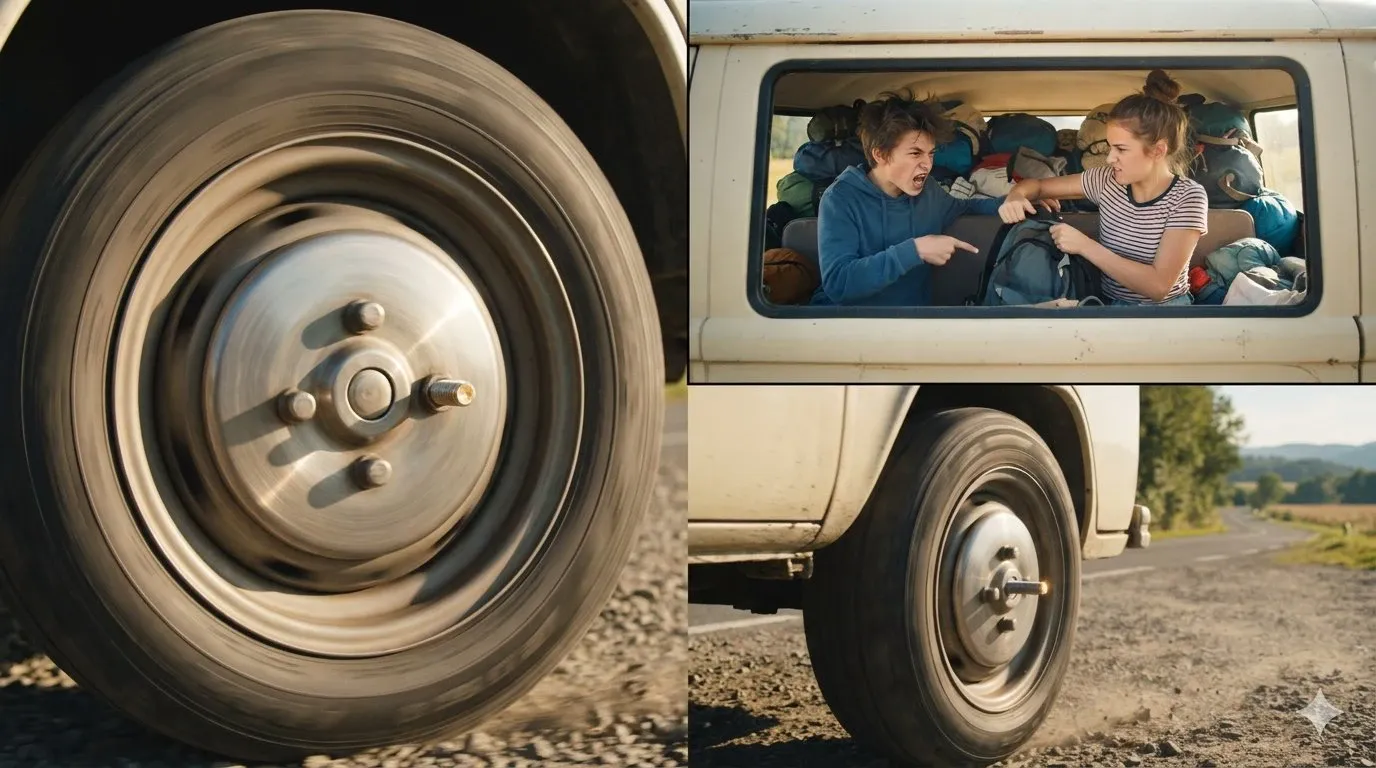
Once we made a series about a family going on a road trip across the country in an old minivan. In the plot, two teenagers were supposed to bicker on the road over who sits where. On paper the line was very funny in itself, but in the edit it turned out that jokes were not enough - the viewer lacked interest (the expectation of change) to wait for the story to start

What saved the story that time was an extra shot: as soon as the car pulls out of the parking lot, a bolt falls off the rear wheel. Suddenly the teenagers' battle for the seat above that wheel became interesting, because we start waiting: who will be sitting above the wheel when it comes off?

A three-shot storyboard: a bolt works loose from a minivan wheel, two teenagers argue in the cabin, the van pulls onto the road

What the "hook - content - CTA" formula cannot do

If you open any breakdown of "how to write a Reels script", you will see roughly the same thing: hook - content - call to action. Sometimes with a fourth element such as a "save trigger". This scheme is not wrong. It is just about something else

"Hook - content - CTA" describes the packaging of a video, not its content. It says where things go, but not what should lie in the middle. The word "content" is a hole in the center of the formula: put anything there and the scheme will not object. That is why videos built strictly by it often look like a stitched-together set of good shots with a voiceover - formally everything is in place, and there is nothing to watch

Story structure answers a different question - why the viewer stays. And it answers through one thing: through the expectation of change that you created and are obliged to answer

The schemes do not compete, they are about different layers. The hook can be the first shot of your story. The call to action can come after the story has ended. But between them there should be not "content" but a working dramatic block

Three levels of a short video: image, scene, story

Before building a structure, it helps to understand which level a video is on now. There are three levels, and they form a ladder

Level 1. Image. Answers the question "what do we see". An empty platform, rain, a person with a suitcase. An image shows and creates mood. It can be very strong - and still remain an image, even if it moves and the shots change

Level 2. Scene. Appears when two things are added: a goal and an obstacle. The hero is after something right now, and something right now stands in their way. A person is rushing for the last train. The viewer gets a question: will they make it or not

Level 3. Story. Appears when a choice and a price grow out of the action. Our hero catches the last train, but it turns out that his ticket is made out in a name he hasn't used in ten years - his real one. Boarding the train now means saying it aloud. Now the question changes: what matters more to him - getting on the train or keeping the secret

This is also where the border between movement and action runs, and it is the most common breakdown in short videos. A woman sorts through boxes in an attic - that is movement. A woman sorts through boxes because the apartment is being sold tomorrow and the letter is somewhere here - that is action. On screen it is the same thing. For the viewer it is two different experiences: in the first case they watch, in the second they wait

A great many videos, especially generated ones, get stuck between the first and second level: there is a character but no action. They walk, stand, look, turn their head, sigh, the camera sweeps around them beautifully. It is unclear whether they are looking for something, running away, late or just walking through a beautiful world. If it is unclear what the hero is trying to change, what we have is not a scene but an image in motion

Reels script structure: hero - goal - obstacle - choice - result

Now let us put the block together. This is the Reels structure that works at any running time from fifteen seconds to several minutes - the density changes, not the set of elements. The first three elements match the logline formula - if a video cannot be retold in one line, the structure will not come together. For how to write such a line, see the article "What Is a Logline"

Hero

The one the viewer follows. In a short format it works better if they can act physically: a person, an animal, a robot, a character. The hero can also be an object, a city or a voice off-screen, but it is easier to follow a living creature, and you have thirty seconds, not an hour and a half

Goal

A specific result the hero is trying to achieve. Not "understand themselves", not "gain confidence" - a camera cannot film that. A goal works when it makes clear what exactly changes and by what sign the viewer will see the job is done

Here hides the difference between process and result. "Is dealing with an inheritance" is a process, it can be dragged out for the whole video without getting closer to anything. "Is racing to sign the waiver before noon" is a result: either they signed or they did not. The verb in the goal must name the outcome, not what the hero is busy with

An abstract desire doesn't disappear, though - it gives the video human meaning. It just needs an outer embodiment. "Wants to stop being afraid" turns into "walks into the house they once ran from". An outer goal does not cancel the inner desire, it gives it a form

Obstacle

A force that says "no". Not necessarily a villain: the obstacle can be time (a timer, a deadline, a departing vehicle), the body, a rule, weather, someone else's decision, one's own fear. It matters that the obstacle is specific and visible, otherwise the viewer cannot judge whether the hero is getting closer to the goal or further from it

Choice

This is the element that is in no social media formula, and it is what turns a video into a story

A choice is not two paths to one result, it is two different results that cannot be had together. The difference is fundamental. If the hero decides whether to climb through the window or go to the door, that is a tactical decision: both roads lead to the same place, they give nothing up consciously, and a price appears only if they make a mistake. If they go down into a mine for someone else's child, knowing that the transport will leave without them, that is an act: the price is built into the successful action itself

The sign is simple: even the hero's complete success cancels something for good. If in your video success costs nothing, you have a scene so far, not a story. For Reels that is normal and often enough - but what gets rewatched is the one where there is a price

Result and change

Take a textbook example: Breaking Bad

In the first episode Walter White celebrates his fiftieth birthday: surrounded by his pregnant wife, his son, friends and relatives. But he does not value himself or those around him and feels unhappy, everything seems to tell him what a loser he is: breakfast is veggie bacon that Skyler has laid out as a "50" on his plate, he is embarrassed to talk about his humiliations at his second job at a car wash, and he watches with envy as his brother-in-law Hank gathers delighted guests and tells them about the latest big arrest. And even his son (!) is proud of Uncle Hank, not of Walter. His birthday present from his wife does not even amount to sex. And the very next day he finds out that he has lung cancer

And Walter decides: to secure his family a comfortable future after his inevitable death, he begins to cook meth. This at once leads to dangerous situations that show him clearly: if he does not stop, he risks not only going to prison himself but also putting his family in danger. It is still possible to quit. What does Walt choose? To continue the crimes, still justifying his choice with care for his family

But then the treatment works and Walt is in remission - he is no longer dying of cancer! He can look after his family without crime. What does he choose? To continue down his path in the criminal world, reaching ever more serious people

Now he has earned the sum needed for a comfortable life and can leave the business safely. What choice does he make? To continue, and to make himself irreplaceable he has Jesse kill Gale, the man who could replace him. And here the family stops being an excuse

And finally Skyler takes Walt to a storage unit where the cash is piled up - more than his family could spend in several lifetimes. He can get out of the game. He did it! And even his family accepts him. What will Walt choose? This time he walks away from the business. But when Hank uncovers him, Walt again chooses the money and his own name over his family and orders a hit on Jesse. And so, through a series of dramatic choices (in a "fork", where you cannot keep everything at once), we arrive at a situation in which the true character of the man Walter always wanted to become crystallizes and is cleaned of the husk of excuses. And we are shown the change

The final season opens with a birthday too. He is fifty-two, alone in a diner, with strips of bacon laid out into a "52" on his plate - a mirror of the "50" from the pilot. There is no family around. The cancer, it seems, is back. It is all the same except for one thing - he is a completely different man from the one who started this path. And there is no way back

That is how change works

The last element is what became irreversible. And here is the main trap: change is not a repeat of the goal. "Wanted to learn the truth - learned the truth" describes the result but says nothing about what reality the hero ended up in. Change sounds different: now he cannot return to his former life; now he sees someone else's world as his own; now he has to live with it. If the second sentence retells the first, there is no change yet
Where to put the twist in Reels

A twist is the moment when what changes is not the situation but the understanding of the situation. The viewer saw one thing, it turned out to be another, and the previous shots are read differently in hindsight

There is one practical rule: the main twist falls at roughly 60–70% of the running time. Earlier - the viewer has not had time to invest in the first version of events, and there is nothing to turn over. Later - there is no room left for consequences, and it is the consequences that give a sense of completeness. For how turning points work in a feature, see the article on three-act structure

  • 30 seconds - the twist at seconds 18–21
  • 60 seconds - the twist at seconds 36–42
  • 90 seconds - the twist at seconds 54–63, and at roughly 35–40 it is useful to add a complication so the middle does not sag

A word on the final shot. In a short video the strongest ending is one that returns to where the video began: the same place, the same hero, almost the same composition. The picture has barely changed, but the viewer now knows the whole path and so reads something else in it. The difference comes not from new scenery but from where the hero now stands within the old one

Three examples: how it looks in a finished video

Example 1. A video shot on a phone. 30 seconds

Night, a club entrance, a line, rain. A girl needs to get inside before the show starts, but she is not on the list, and the phone with her e-ticket has just died. At the twentieth second she notices someone in line she broke up with badly - he has a way in. Then comes the choice: leave with her pride intact or ask him for help. She goes inside and ends the video in his debt

Not a single special effect, it can all be shot on a phone at any entrance. What works is not the production but that by second five the viewer already knows what they are waiting for

Example 2. An AI video. 90 seconds

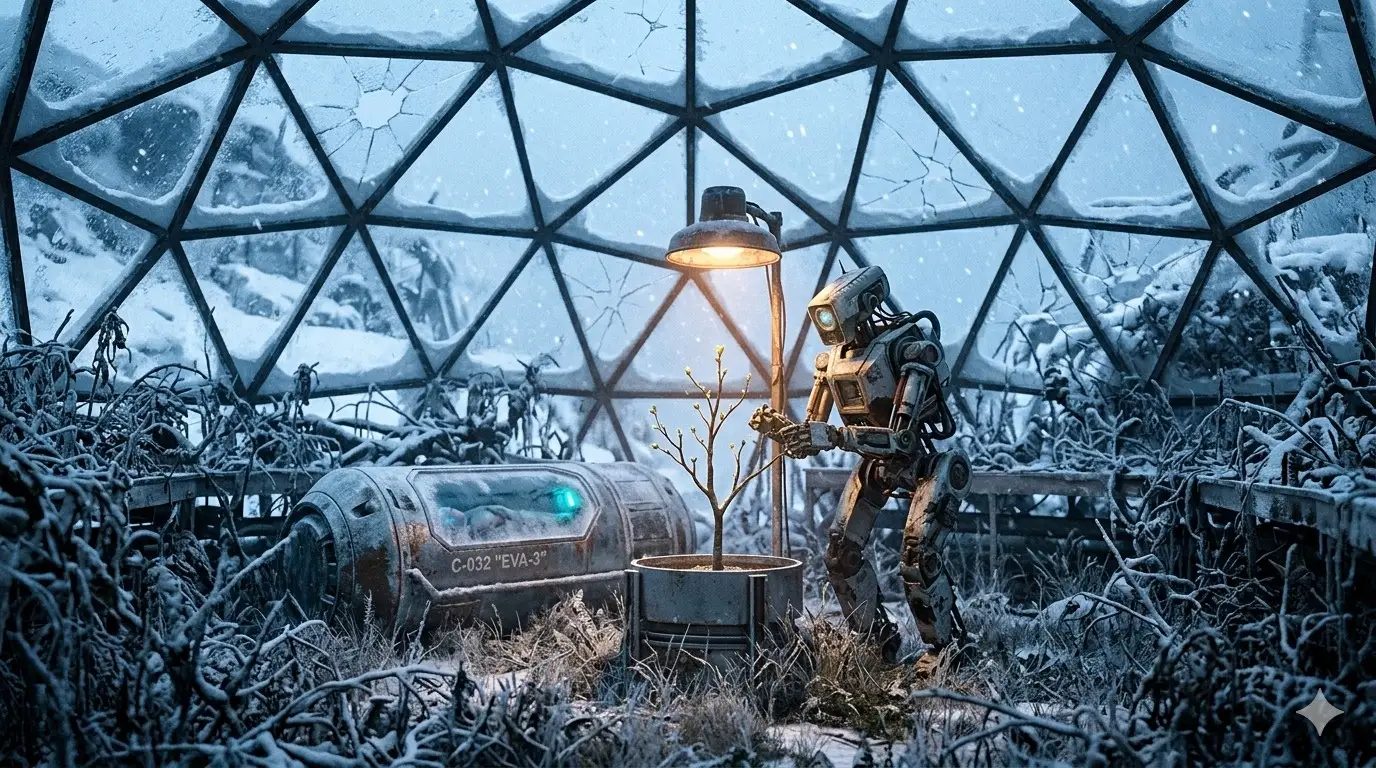
Image. An abandoned greenhouse under a glass dome, snow outside, inside a gardener robot and one living tree. A typical generation, the kind hundreds of videos start with and none finishes

An abandoned greenhouse under a snow-covered dome: a gardener robot beside a single sprout, a cryo chamber nearby
  • Hero - the gardener robot
  • Goal - bring the tree to bloom: switch on the lamps above it
  • Obstacle - the generator powers only one circuit of two
  • Complication (≈ second 38) - in the second circuit a cryo chamber comes alive: inside is the person who built this robot
  • Twist (≈ second 58) - a record turns up in the archive: the person went into cryosleep precisely to wait for the bloom. Waking them now means undoing what they lay down for
  • Choice - bring the person back at once and lose the tree, or let the tree bloom and risk that by then there will be no one left to wake
  • Change - the robot sends power to the lamps. In the last shot it is the same greenhouse, but there is light over the tree and the cryo chamber indicator has gone out, and the only one to see the bloom is the one it was never meant for

Here you can see what exactly the neural network does and what the author does. Generation gives the first level perfectly: atmosphere, image, texture. It is not its job to turn mood into an experience for the viewer - and without that the video sprawls: a shot, another shot, one more interesting turn of the world, and the story still does not begin

Example 3. An expert Reel. 60 seconds

The structure works where there is no fiction too - in a video where a person is simply doing something to camera

Image. A workshop, a vintage record player on the table

  • Hero - a craftsman
  • Goal - repair the record player by evening: it was brought in as a gift, the owner is coming for it today
  • Obstacle - the needed part has not been made for forty years
  • Twist (≈ second 38) - a modern part fits, but the sound will be different
  • Choice - hand over a working machine that is not what it was, or hand over an unrepaired one, honestly
  • Change - the craftsman fits the new part and tells the owner aloud that it is no longer the same sound

It is still "how I repaired a record player". But the viewer watches to the end not for the process but because they wait to see what the craftsman will pay

Common mistakes in a short-video script

  1. A character but no action. They walk, look, sigh. It is unclear what they are trying to change - and the video stays an image in motion
  2. The goal is worded as a process. "Trying to work things out", "searching for themselves". The viewer cannot tell whether it got closer or further
  3. The goal is too small. "Open a door" is solved in three seconds, and after that the video is empty: such a result cannot carry the whole running time
  4. A choice replaced by a tactical decision. Two ways to do the same thing instead of two incompatible results
  5. The change repeats the goal. "Wanted to make it - made it". The video ends but does not conclude
  6. The twist sits in the last second. The meaning flipped, but the viewer did not see the consequences
  7. A bet on the number of shots. One more beautiful shot instead of an answer to what the viewer is waiting for right now

A template by seconds

The timings below are a guide, not a law. They can be shifted; what cannot be done is changing the order of the elements: a choice without a stated goal does not read, a change without a choice turns into a retelling

30 seconds

Seconds What happens
0–3 who is in the frame and where
3–10 what the hero is after and what stands in their way
10–18 attempts; the viewer waits for a result
18–21 the twist: the understanding of what is happening changes
21–27 the choice and its price
27–30 the final shot: the hero's new situation

60 seconds

Seconds What happens
0–6 who is in the frame and where
6–18 the goal is stated, the obstacle is named
18–36 attempts under growing pressure
36–42 the twist
42–54 the choice and its price
54–60 the final shot

90 seconds

Seconds What happens
0–10 image, mood, hero
10–25 goal and obstacle
25–35 the first line of attempts
35–40 a complication: the task gets harder
40–54 pressure grows, and so does the price
54–63 the twist: the meaning of what is happening changes
63–80 the choice and the loss
80–90 the final shot

Three questions for a video you have already shot

The easiest way to see the difference is not on an idea but on what is already edited. It is worth asking an edited video just three questions

What is the viewer waiting for at second five? If the answer is "beautiful shots" - only the mood is working, and there is nothing left to hold attention

What turns over along the way? If nothing, the video will end where it began, and there is no reason to rewatch it

What does the hero pay for the result? If success costs nothing, what you have is a good scene. It becomes a story where winning has to be paid for with something

Videos that are not watched to the end almost always stumble on the second and third questions

What next

A hook buys three seconds, structure buys the remaining twenty-seven, fifty-seven or eighty-seven. These are different tools, and the second hardly appears in breakdowns, though it is the one responsible for watch time

MOONK Academy runs a nine-lesson course on story structure, where each participant works with their own material. See the course